From Vitré to Lac du Lambon

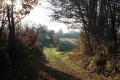
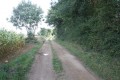
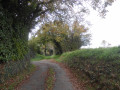
A beautiful, varied walk starting around Lac du Lambon and continuing through a hilly area and across the Mellois plateau, dotted with numerous castles, manor houses and other traditional buildings. Note the many shaded paths, sometimes running between embankments, which lend a special charm to this route.

Details

744394
Creation:
Last update:
Last review:
  • Walking
    Activity: Walking
  • ↔
    Distance: 7.19 mi
  • ◔
    Average duration: 3h 45 
  • ▲
    Difficulty: Moderate

  • ⚐
    Back to start: Yes
  • ↗
    Ascent: + 476 ft
  • ↘
    Descent: - 453 ft

  • ▲
    Highest point: 522 ft
  • ▼
    Lowest point: 351 ft

Photos

Description of the walk

The car park is located near Vitré Town Hall (behind it).

(S/E) Leave the car park and head towards the D103 road (eastwards). When you reach the D103, turn left. Pass Rue de l’Égalité on your right, then a road on your left leading to La Bertamerie. The D103 then takes a wide bend to the right. After passing some houses on the left, turn left onto the farm track and leave Vitré. Further on, pass under a high-voltage power line.

A little further on, cross a road and continue straight ahead along the grassy track opposite (if there are too many nettles, walk along the edge of the field on the right-hand side). Then cross another road and continue straight ahead along the road opposite known as La Touche (a beautiful private property on the left). The road now descends.

(1) Just past the houses in the hamlet of La Chercôte and when the road turns sharply right at a 90° angle, take a path on the left. Head west, keeping to the hillside below a property. As you enter the woods, you’ll come to a T-junction.
N.B. If you turn left, you can visit a wash house and fountain about a hundred metres further up (then retrace your steps).
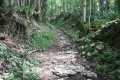
Turn right onto the narrow, stony path leading downhill, which after about a hundred metres leads to the road that circles Lac du Lambon. This section is very stony and can turn into a stream during periods of heavy rain. Upon reaching the lakeside, turn left and take the road that runs along the edge of Lac du Lambon to the leisure centre.

(2) The road running alongside the Lambon crosses the lake’s outlet via a bridge. Adventurous types may also wish to try the rope bridge located right next to it. Continue straight on and walk around Lac du Lambon, passing through the Leisure Park. The road passes beneath the hamlet of La Paillaudière and arrives at the other end of the lake. Turn left onto the road that joins the road coming from La Paillaudière. Then turn right.

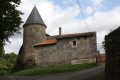
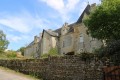
(3) You’ll reach a crossroads; go straight across and take the road opposite leading to La Bessière. Shortly afterwards, as you reach the hamlet of La Bessière, ignore a dead-end road on the right leading to the houses. La Bessière is a residence converted from a small 15th-century castle that has retained its defensive towers. It was restored and extended in 1880. The road winds along the hillside, overlooking a stream on the left.

(4) At the first junction with a grassy path on the left, turn left onto it. After 150 metres, you can take a path down to the wash house and the source of the Cibaudière.
Further on, pass a path on the left, continue, then take a right-hand bend. At a right-angled bend to the left, ignore the path heading south at this point and continue along the path heading north.

The path turns into a road and, a little further on, passes in front of Lussaudière Castle: ignore the two farm tracks on the left that go round the castle, as well as the third farm track, also on the left, which leads to farm buildings. The road reaches the houses at Lussaudière.

(5) Take the farm track on the right before entering the hamlet of Lussaudière. This track joins the road which marks the southern exit of the hamlet of l’Houmellerie. Turn right onto this road. It passes near the hamlet of la Caunay. Pass two streets on the right, serving the houses in the hamlet, and a farm track on the left.

(6) Immediately after the T-junction: turn right. Just as the road takes a right-angle bend to the right to serve the hamlet of La Caunay, take the farm track opposite, heading downhill.
Further on, pass a track on the right heading north.

(7) Shortly afterwards, take a path on the left that leads downhill towards the hamlet of La Banissière. The path comes out onto a road which you cross straight ahead to take a track opposite leading to the hamlet of La Banissière

(8) This track joins a road: turn right and almost immediately turn left onto a sloping street that quickly turns into a path. The path leads to the hamlet of Six Chiens. As you pass, admire the spring and the wash house below La Banissière, as well as the water ram. The water ram is easy to spot thanks to its audible thumping (it only works if there is enough water, of course).

You cross the Lambon stream via a pretty stone bridge. The climb up to the hamlet of Six Chiens follows a stony path. When you reach the road, turn left and immediately turn right onto an uphill path.

(9) Towards the top of the hill, turn right onto a level path leading towards Château Gaillard (farm). The path joins a road that is circular and serves the houses. Continue straight on; the road then turns sharply left. Pass the track leading to the Logis de Crouzon on your right. The road leads towards the hamlet of Crouzon.

On arrival, pass the first road on the left and immediately take the second on the left. At the next junction, in Crouzon, turn right. Pass a track on the left. The road turns into a farm track and then a simple path a little further on. These are slightly downhill. Continue to the next junction of paths.

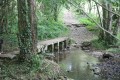
(10) Continue to the right down a fairly steep slope towards the bottom of the valley on a path overgrown with grass. Cross the stream via a bridge made of large stones and climb up the other side of the valley. The path passes under a high-voltage power line several times (3 times). At the next crossroads, turn right onto a path that runs flat towards the west before turning right and descending towards a road.

(11) When you reach the road, turn left. At the next junction, turn left again and then immediately right onto a road leading back to Vitré. At the start of this narrow road, there is a ‘no entry except for residents’ sign.

Further on, the road joins the D108: turn right. Pass Rue des Écoles on your left. Shortly afterwards, turn right into Rue de l’Égalité and walk past the cemetery. At the end of Rue de l’Égalité, turn left and then immediately right. The route returns to the car park, which marks the end of this walk (S/E).


Waypoints

  1. S/E : mi 0 - alt. 443 ft - Car park behind the Town Hall
  2. 1 : mi 1.02 - alt. 417 ft - Road-path junction
  3. 2 : mi 1.42 - alt. 361 ft - Junction of farm track and road
  4. 3 : mi 2.38 - alt. 374 ft - Crossroads
  5. 4 : mi 2.7 - alt. 427 ft - Crossroads: road – track
  6. 5 : mi 3.62 - alt. 518 ft - Crossroads – farm track
  7. 6 : mi 4.01 - alt. 518 ft - T-junction
  8. 7 : mi 4.51 - alt. 499 ft - T-junction
  9. 8 : mi 4.83 - alt. 463 ft - Crossroads at La Banissière
  10. 9 : mi 5.36 - alt. 505 ft - Crossroads
  11. 10 : mi 5.89 - alt. 423 ft - Y-junction
  12. 11 : mi 6.44 - alt. 397 ft - Path-road junction
  13. S/E : mi 7.19 - alt. 443 ft - Car park behind the Town Hall

Notes

This walk, over varied terrain, requires sturdy footwear. Especially as some sections are on stony paths.
In stormy weather, this walk should be avoided as the route passes under a high-voltage power line on several occasions.
Similarly, after heavy rain, some short sections of the route may turn into streams.

Alternative route to shorten the route by nearly 2 km
In the hamlet of La Chercôte, turn right instead of left, go round the houses, then take the path at the end of the street. This path joins a road: take the road on the left that goes downhill. Before the bridge crossing the Lambon, turn left then right to join the farm track that runs alongside Lac du Lambon. The track soon joins the route that has passed beneath the hamlet of La Paillaudière.

Worth a visit

After (8), the hydraulic ram is easy to spot thanks to its audible thumping (it only works if there is enough water, of course). It is a device invented by the Montgolfier brothers in 1795. It is used to pump water up a pipe by harnessing the speed of the water coming from upstream. In this case, it is spring water. This device allows for a head of around ten metres and was used to supply the garden and the drinking troughs of a farm.

Melle
Melle lies on the Via Turonensis route of the pilgrimage to Santiago de Compostela, on the Poitiers–Saintes axis. The town is built on a promontory situated in the centre of the Mellois plateau.
The town’s ancient name, ‘Metullum’, is of uncertain origin. Some have seen it as a corrupted form of the Latin metallum (mine, metal), or a derivative of metula (the small boundary marker). It is more likely that this name derives from the Celtic root metl, well attested in place names, whose exact meaning is debated: height? enclosure? but more certainly harvester (metelo-)

In addition to its remains of medieval fortifications, Melle boasts three interesting Romanesque churches. Their construction took place between the late 11th century and the mid-12th century, offering a condensed overview of the architectural evolution of that era in a single location. This group is known as the Romanesque Triad of Melle.
The Church of Saint-Hilaire, listed as a Historic Monument since 30 March 1887. It has also been a UNESCO World Heritage Site since 1998, as a stop on the Way of St James in France.
The Church of Saint-Pierre.
The Church of Saint-Savinien.

The Hôtel de Ménoc or Bishop’s Palace.
The Arboretum.
The silver mines of the Frankish kings.

Other places of interest:
Via Turonensis: the route from Tours to Santiago de Compostela, taken by pilgrims on the Camino de Santiago, passes through the town. A municipal lodge has been opened to accommodate hikers onthe GR® 655, complementing the family-run accommodation provided mainly by former pilgrims.
A Protestant church, built in 1836, which is very spacious and is sometimes used as an exhibition hall.
Baltard-style market halls built in 1903 by Mr Mongeaud, the departmental architect. They stand on the site of the former wooden market halls built in 1836.

The market halls of Melle.
An Art Deco-style metal bandstand, built in 1930.
An Art Nouveau gateway.
The Villiers wash house, with its oval basin, a rarity in western France. It is sheltered by an octagonal roof structure pierced with arches. Other wash houses can be seen in the vicinity of Melle: the Loubeau wash house, the Fontaine au Beurre, and the Saint-Thibault wash house.
The hospice, with its beautiful 17th-century door from the convent of Puy-Berland, is distinguished by the drapery wrapped around its columns and the carved corners in the spandrels of the archivolt.
Of the fortifications, only a few fragments remain: a tower on Rue des Fossés, and sections of towers in the old ramparts that still overlook Rue de la Petite-Motte.

Beaussais
The Protestant Church, housed in a former 12th-century Romanesque church.
The House of Protestantism.
Château la Boulaye in Beaussais-Vitré - 79370 - 15th century - It is a manor house.

Celles-sur-Belle
The town lies between Niort and Melle in the Deux-Sèvres department, within the Pays Mellois region, of which it has been the most populous town since 2009, overtaking Melle. However, the village of Celles remains modest with around 1,600 inhabitants, and has retained its character as a quiet little village, particularly since the construction of the bypass.
It is situated on one of the routes to Santiago de Compostela, between Poitiers and Bordeaux: the Via Turonensis.

Places and monuments:
The 12th-century Royal Abbey of Celles-sur-Belle, situated on the Way of St James.
12th-century church of Romanesque architecture, later rebuilt in the Gothic style.
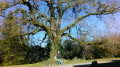
The ‘talle à teurtous’ (chestnut tree for everyone), a remarkable tree. A ‘talle’ is a grafted chestnut tree grown for fruit production. This one gave its name to the spot where it stands in the hamlet of La Revêtizon. The main trunk, with a circumference exceeding 7m at a height of 1.80m, has been dead for several years; however, two suckers growing around it have given it a new lease of life. The tree has a total circumference of 11.65m at a height of 1m.

Always be cautious and plan ahead when you're outdoors. Visorando and the author of this route cannot be held responsible for any accidents occurring on this route.

The GR® and PR® markings are the intellectual property of the Fédération Française de Randonnée Pédestre.

Reviews and comments

4.4 / 5
Based on 4 reviews

Reliability of the description
4.5 / 5
Ease of following the route
4.5 / 5
Route interest
4.3 / 5
Jacques gomes
Jacques gomes

Overall rating : 4.7 / 5

Date of your route : Apr 07, 2026
Reliability of the description : ★★★★★ Very good
Ease of following the route : ★★★★★ Very good
Route interest : ★★★★☆ Good
Very busy route : No

I managed it despite the difficult conditions caused by heavy rain, mud, slippery ground and so on.

Machine-translated

MARTDomi
MARTDomi

Overall rating : 4 / 5

Date of your route : Jul 19, 2024
Reliability of the description : ★★★★☆ Good
Ease of following the route : ★★★★☆ Good
Route interest : ★★★★☆ Good
Very busy route : No

A lovely circular path. Lots of little paths and trails.

Machine-translated

piot
piot

Overall rating : 4 / 5

Date of your route : Dec 19, 2022
Reliability of the description : ★★★★☆ Good
Ease of following the route : ★★★★☆ Good
Route interest : ★★★★☆ Good
Very busy route : No

The meeting point isn’t easy to find because the municipalities of Vitré and Beaussais have merged, and the sat-nav takes us to Beaussais Town Hall rather than Vitré

Machine-translated

pgetrochon
pgetrochon

Thank you for your message. I’m glad you enjoyed the route.
Happy hiking

Machine-translated

romsteak79
romsteak79

Overall rating : 5 / 5

Date of your route : Jul 20, 2020
Reliability of the description : ★★★★★ Very good
Ease of following the route : ★★★★★ Very good
Route interest : ★★★★★ Very good
Very busy route : No

A brilliant hike with some fantastic trails around Vitré – definitely one to do again with friends.

Machine-translated

Other walks in the area

For more walks, use our search engine .

The GPS track and description are the property of this route's author. Please do not copy them without permission.