Country:
 City:
City:


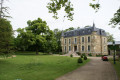
Departure: Château des Tourelles Park, 19 Avenue de la Maréchale.
(S/E) Walk up Avenue de la Maréchale and turn left at the next junction onto Avenue du Domino Noir. At the end of the street, take the left-hand exit at the Rond-Point du Val Roger and turn left onto the avenue of the same name.
(1) At the next crossroads, situated in the centre, the Grille du Château de la Lande is the last remaining visible vestige of the old building demolished in 1943. Continue straight ahead, past the gate, onto Avenue du Parc de la Lande. At the junction, where the road splits into two, take whichever of the two streets you prefer; they rejoin further on. At the junction with Avenue du Chemin Vert, turn right, then left at the junction with Avenue du Tramway.
(2) At the roundabout, continue straight ahead towards the town centre along Avenue Ardouin for 300 metres. In the heart of Plessis-Trévise town centre, after the Jean Duhamel media library, at the fork by the kiosk on the covered market esplanade, continue to the right along Avenue Ardouin. 100 metres further on, on your right, preceded by a garden with straight lines, an elegant bourgeois villa, built in 1866, has housed the Plessis-Trévise town hall since 1923.
(3) Continue and, after 400 metres, at the roundabout, take Avenue Saint-Pierre on your right. Then go straight through the next roundabout, heading straight ahead. At the next junction with traffic lights, continue straight on for 700 metres along Avenue Maurice Ponroy. At the end, this road becomes a footpath called Chemin des Bordes au Plessis, leading you to the heart of the Plaine des Bordes. This former 58-hectare agricultural plain, classified as a sensitive natural area, includes a market garden, apiaries and allotments.
(4) Follow this path for 500 metres to the roundabout in the heart of the park. Continue straight on along Rue des Bordes. 150 metres after thesecond roundabout , at the exit near No. 86, you will find the Plaine des Bordes Departmental Park.
(5) Continue along Rue des Bordes and turn left at the next junction onto Avenue Champlain. 150 metres further on, on your right, is the Regional Archery Training Centre. It is one of the largest centres for this discipline in the world. Established here for 160 years, the centre can accommodate groups, by booking, to introduce them to this sport of precision and concentration.
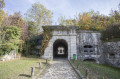
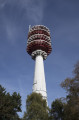
(6) Retrace your steps and turn left onto Rue des Bordes, continuing to the junction 1 km further on with Route de la Libération. Turn right onto it and follow this road for 1.5 km, heading towards the radio mast, easily recognisable from a distance by its height and its red and white colours. Completed in 1972 and standing 120 metres tall, it serves as an antenna for digital television and mobile phone signals. At the junction with Rue Molière, cross at the pedestrian crossing and take the left-hand pavement. 150 metres past the petrol station, turn left into a street leading to the rear entrance of the Parc du Fort de Champigny. Then follow the footpath to the right, running alongside the fort’s moats.
(7) Continue along the path that takes you round the semi-buried building on the left.
(8) Cross at the pedestrian crossing opposite the fort’s car park to take the pavement on the opposite side and head down Rue Aristide Briand to the left. At the next junction, turn right into the street named Place Mon Idée. After 50 metres, continue along the grassy path, cross two streets, including Rue Pierre Boucharinc, and continue along the footpath. At the end, take Ruelle Colombert opposite until the next junction. At the police station, turn right and, near the car park, stop off at Parc Corot, created in 1959 by the local council following the acquisition of the property belonging to Mr and Mrs Corot.
(9) Then turn right onto Rue du Pont, then left onto Rue du Général de Gaulle, heading towards the Espace Charles de Gaulle. Recognisable by its turret, the building houses the wedding hall. At the entrance gate to the Espace Charles de Gaulle, take the footpath along the Passage de l’École and go down the steps to reach Rue du Pont below.
(10) After taking a closer look at the vines, continue down the street, then cross at the next pedestrian crossing. Take the pavement on the right. After 150 metres, turn right onto Rue de la Marne. At the end, turn right onto Avenue de la Gare, until you reach No. 34, where the former Chennevières railway station is located. Built in 1929 on the “Grande Ceinture de Paris” line, this building, clad in salmon-pink brick, with a cut-stone base and light green ceramic decoration, bears the inscription “Chemin de Fer de Ceinture”.
(11) Continue along Avenue de la Gare and, at the next junction, turn left onto Rue d’Houin, passing under the railway line. At the end, turn left onto Rue de Champigny.
(12) At this junction, the restaurant l’Écu de France faces the Marne. Continue for 700 metres, passing the Château de l'Étape. On the hillside and along the banks of the Marne, admire the old holiday homes with their Anglo-Norman architecture or the Art Nouveau-style millstone houses, including part of the Château de l’Étape complex at No. 4. Before 1865, Chennevières was reached via a ferry that docked nearby.
(13) Continue on and cross the bridge,admiring the views of the river and the wooded river island of Casenave on either side. Continue straight ahead along Avenue du Bac for 700 metres to La Varenne – Chennevières station on the RER A line (E).
 Visorando Member
 Moderate
 Association / Club / Walk leader
 Difficult
  Local authority